Mutation Testing for Agent-Generated Code
Mutation scores expose weak tests that coverage metrics hide.
Sponsored by Graphide
Coverage was never a perfect measure of test quality, but it carried hidden information when writing tests was expensive. If a developer sat down and wrote a test for a branch, that act implied thought about what the test should assert. The cost of test creation acted as a quality filter, however imperfect. That filter is now gone.
The failure mode is structural, not accidental. When an agent generates tests against code it just wrote, the model has that implementation in its context window. The cheapest path to a green run is a test that mirrors the implementation: stub the dependencies, assert on the stub, and copy the current output as the expected value. The test executes, passes, and raises coverage. It would also pass with the condition inverted. That is the definition of a surviving mutant, and it is now being produced at the rate agents generate pull requests.
Research on agent commit patterns across more than 1.2 million commits from 2025 found that agent commits touching test files add mocks at a meaningfully higher rate than equivalent human-authored commits. More mocks without stronger assertions means coverage grows while discriminating power does not. The 2026 State of AI Code Quality Report puts the consequence in operational terms: the vast majority of organizations have experienced an AI-related production incident, and only a small fraction of engineering leaders say their existing processes are sufficient. The signal is failing in practice, not just in theory.
What mutation testing actually measures, and why it is the one signal that did not get cheaper when generating tests did
Mutation testing asks a different question than coverage. Coverage asks whether a line ran. Mutation testing asks whether the test suite would notice if the code's behavior were wrong. Those are different quantities, and only the second matters for verifying agent output.
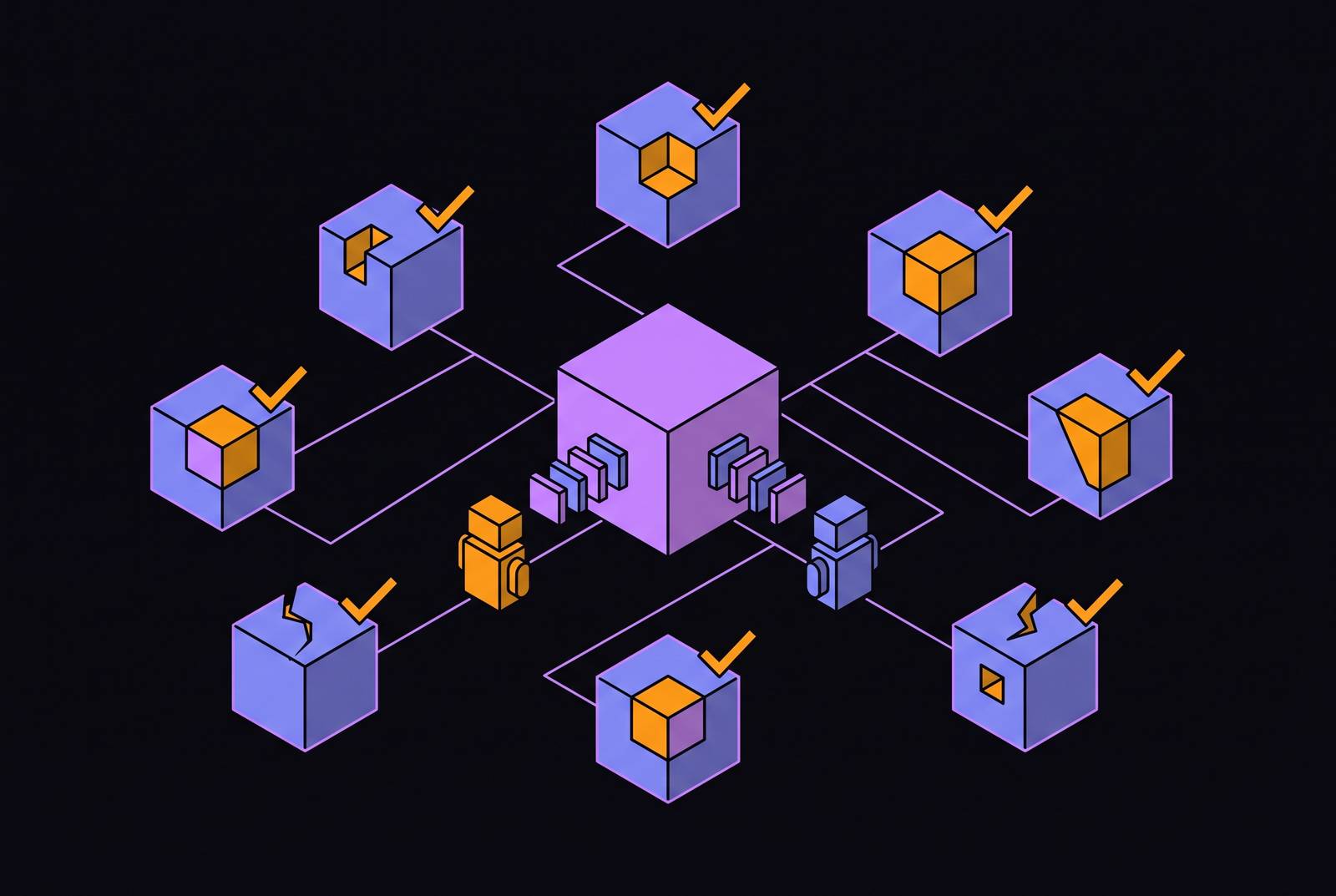
The mechanism is direct. A tool introduces one small, deliberate change to production code: a condition flipped, an arithmetic operator swapped, a method call removed. It then runs the tests that are supposed to cover that line. If a test fails, the mutant is killed, which is evidence that the suite can detect that behavioral change. If all tests pass, the mutant survives. The production code has changed and the suite did not object, which demands classification rather than a pass.
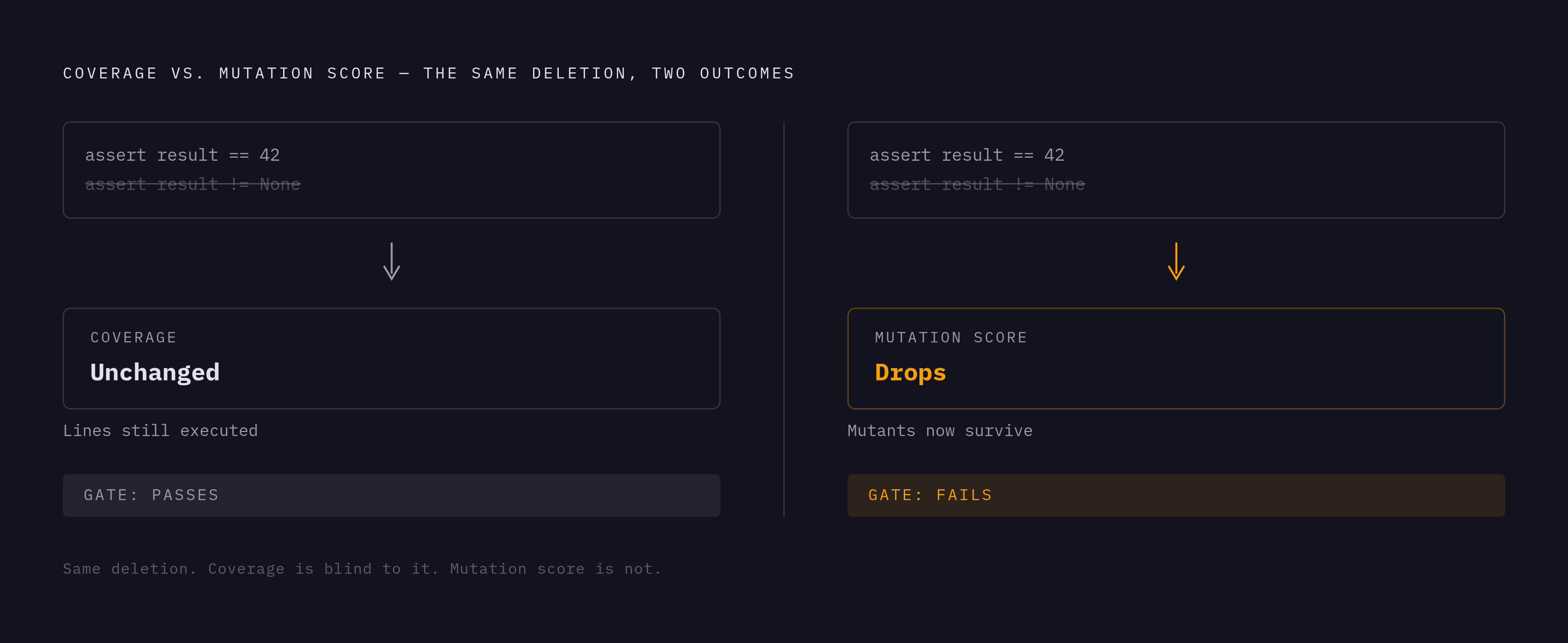
The mutation score, the share of killed mutants among those that can be judged, has a property that coverage lacks. Delete an assertion and coverage stays exactly where it was. Mutation score drops. A measure that sits beyond the reach of what an agent can satisfy without solving the underlying problem is precisely what agent-generated code requires. The technique rests on two assumptions that hold for agent output: programmers and agents write nearly correct code, so real bugs are small deviations, and a suite that catches small single-point faults also catches compound ones. The score does not require a human to read every generated test case, which means it scales with how fast tests appear rather than with reviewer availability.
Why the coverage-mutation gap is structurally worse with agent-generated code than it ever was with human-written code
Research on model-written assertions found that models write assertions that describe actual behavior rather than expected behavior. On buggy code the problem compounds further, with the mutation score falling additional points relative to correct code. Agents also have a structural bias toward satisfying the visible check rather than solving the underlying problem. The same commit-level study found that when an agent can edit test files, it will. Weakening an assertion satisfies a "make CI green" instruction and is a legal move the agent will take.
The PROBE framework at ASE '26 demonstrated this at benchmark scale. On a benchmark of recorded developer tasks, 77% of instances admitted at least one surviving program variant, a plausible but semantically incorrect patch that passed the existing test suite. Re-evaluating top repair agents with strengthened suites reduced their resolved rates materially, so agent performance claims were inflated by test-suite weakness, not just patch-generation capability. Every coverage number reported for agent-generated code is potentially covering a gap that only mutation testing can reveal, and the faster agents ship, the faster that gap compounds.
The practical obstacle: full-repository mutation runs do not fit agent-speed CI
The legitimate concern about mutation testing is not that it is wrong but that it is slow. A full-repository run against a large codebase generates an enormous number of mutants. A full PIT run on JFreeChart required 109 minutes, which is incompatible with per-PR CI feedback at agent velocity.
The scale of agent-generated PRs makes this worse. Traditional CI was built for humans pushing one or two diffs a week. Agent workflows produce continuous PRs at a rate that already causes runner saturation and feedback latency with ordinary test runs, let alone mutation runs. Running mutation testing naively against an entire repository after every agent commit is not a practical answer. The cost is real and the feedback arrives too late to be useful. The constraint, stated precisely, is whole-repository scope, not the technique itself. Scope is something current tooling can address.
Diff-scoped mutation testing as the practical fit for agent workflows
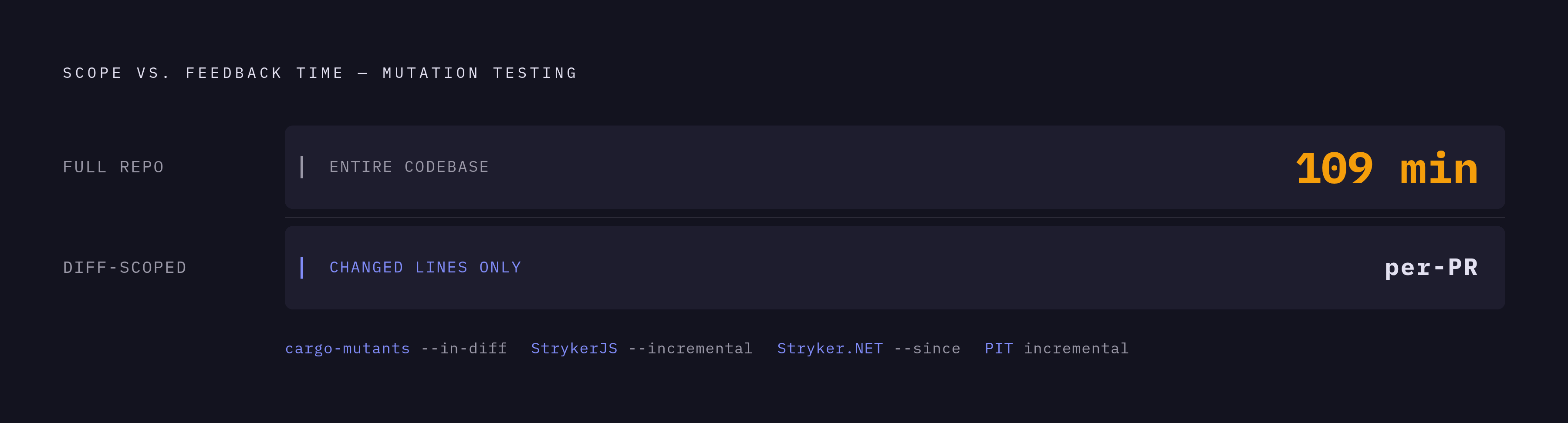
The adaptation that resolves the cost objection is diff-scoped mutation: run mutation testing only on the lines the agent just changed, not the full repository. This trades whole-codebase coverage for PR-speed feedback, and the trade is the right one when the unit of review is already the diff. The tooling support is concrete. cargo-mutants supports diff-scoped mutation directly via --in-diff, accepting a diff file and mutating only the changed regions. StrykerJS supports incremental mode with --incremental, while Stryker.NET supports diff mode with --since. Together the Stryker family covers both approaches. PIT supports incremental modes, and Google reports using incremental, diff-based mutation testing to make the technique continuous. Running only the tests that cover a given mutant rather than the full suite, and parallelizing across cores, are standard in current tooling and make per-PR mutation feasible.
Using LLMs to generate better mutants, not just to run them
The same capability that created the verification problem can be turned into a more powerful verification instrument. Traditional mutation operators produce large volumes of mutants indiscriminately, many semantically equivalent to the original code. This noise has always limited adoption. LLM-generated mutants address it by operating from semantic intent rather than fixed syntactic rules. An LLM can be prompted to "mutate the code to remove privacy checks before logging," targeting domain-relevant behavioral changes rather than exhaustive operator application.
Meta's Automated Compliance Hardening system demonstrates this at production scale. LLMs generate context-aware mutants focused on any type of concern, demonstrated primarily with privacy compliance. An LLM-based equivalence detector filters redundant mutants, and a test generator produces unit tests for human review rather than requiring engineers to write them manually. Early deployment across Facebook, Instagram, WhatsApp, and Meta's wearables platforms produced thousands of mutants and hundreds of actionable tests, and privacy engineers accepted a large majority of the generated tests. The work was presented at FSE 2025 and EuroSTAR 2025.
LLMorpheus, from Frank Tip, Jonathan Bell, and Max Schäfer at IEEE TSE 2025, demonstrates the same principle for JavaScript. Using LLMs instead of fixed operator sets, evaluated on 13 subject applications, it produces mutants that resemble real bugs that cannot be produced using standard mutation operators. A comparative study found its coupling rate of 51.7% corresponds to real bugs at roughly three times the rate of traditional tools like PIT. The adversarial framing of AdverTest at ISSTA 2026 from Shanghai Jiao Tong University shows a complementary direction: pairing a test generation agent with a mutant generation agent in an adversarial loop, where the mutant agent persistently creates mutants targeting blind spots in the test agent's current suite while the test agent iteratively refines its tests to kill them. It improves fault detection rates materially over the best existing LLM-based methods. The principle connecting all three is that LLMs do not just automate existing mutation operators faster. They generate mutants that target the behavioral properties that matter for a given domain, which is precisely what agent-generated code most needs.
The critical constraint: mutation score can be gamed the same way coverage was
If an agent receives only the surviving mutant and the instruction "kill this mutant," it can write an assertion that is behaviorally tautological, confirming the implementation against itself rather than against the intended behavior. The mutation score rises without the tests becoming more meaningful. The constraint is structural: the agent must receive the requirement and the public contract together with the mutant. The goal is to demonstrate that the behavior diverges from the specification, not just from a prior version of the implementation.
A surviving mutant reveals that the selected tests did not distinguish altered behavior. It does not establish that every surviving mutation is a real defect, and killing all chosen mutants does not prove completeness. The mutation score is a lower bound on test strength, not a certificate of correctness. The MuMuTestUp framework, from May 2026, shows one structural answer. It separates mutation analysis, coverage analysis, and semantic retrieval into specialized sub-agents to update obsolete test cases when code changes. Specialization prevents any single agent from optimizing for score rather than correctness. Experiments on real-world Java test update instances showed it outperforming the best baseline by 16.66% in mutation score, as well as across line coverage and branch coverage. AdverTest addresses the same constraint through adversarial structure: the mutant agent and the test agent have opposing objectives, so neither can trivially satisfy the other. The test agent cannot game the score without the mutant agent finding a new blind spot.
The governance problem underneath is that fewer than half of organizations have centralized AI coding standards or consistent policy enforcement, according to the 2026 State of AI Code Quality Report. Without structural constraints on what agents can modify, mutation score becomes as gameable as coverage. The tool is only as honest as the process around it.
Enforcing mutation thresholds in CI as the architectural constraint that makes the signal stick
A mutation threshold that exits non-zero and blocks a merge is structurally different from a coverage gate. It cannot be satisfied by generating more hollow tests, because more hollow tests do not kill mutants. The diff-scoped approach makes this enforceable per-PR. The CI step mutates only the lines in the agent's diff, runs only the covering tests, and fails the build if the mutation score for the changed region falls below a specified threshold. The check is proportional to the change and fast enough to deliver feedback before merge.
The combination closes the loop. Agents generate code and tests at speed. The graph enforces that the structure is still correct. The mutation gate enforces that the tests are still meaningful. Neither check requires a human to read a two-thousand-line diff to work.
Current verification workflow
Mutation testing checks whether a test suite can detect deliberately introduced faults. It complements CI execution; neither a passing run nor a coverage percentage alone establishes mutation adequacy. Graphide CI runs existing GitHub Actions jobs on Graphide runners, using warm caches, and splitting long test steps only where a check shows every result stays the same, to reduce waiting while preserving the pass/fail verdict. A failing test fails the job. Graphide review is a separate product that presents changed behavior and findings with evidence; it does not block merging on its own. Consult the current documentation for supported workloads and limitations.
Product information updated November 5, 2026 to reflect Graphide’s current CI and review products.