GitHub Actions Runner Migration for Agent-Heavy Teams
How to speed up CI for agent-driven PRs without changing verdicts.
Sponsored by Graphide
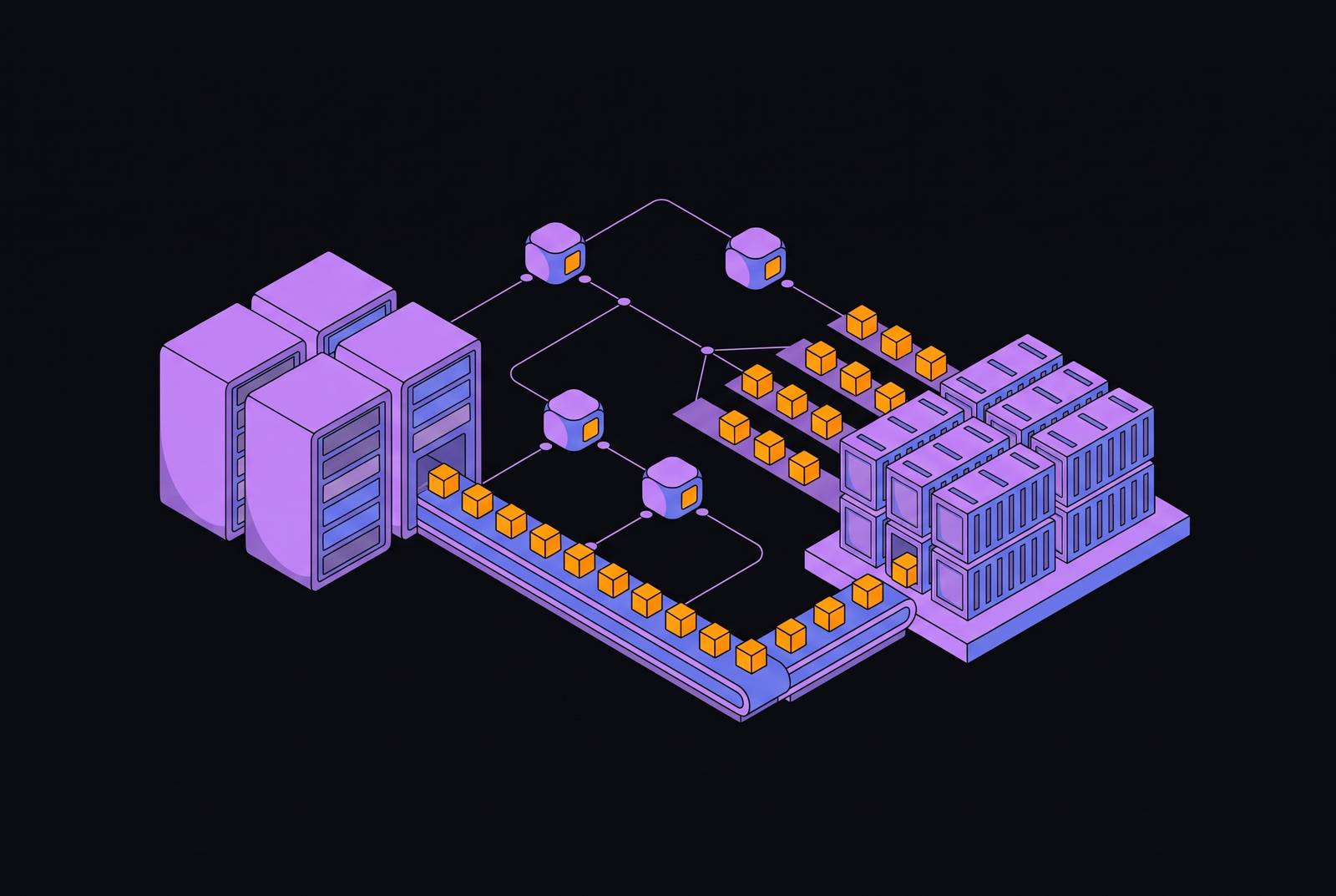
Migrating GitHub Actions runners is the highest-leverage response when coding agents generate pull requests faster than CI can verify them. The provider switch alone is not enough. Teams need warm caches, suitable runner sizes, balanced test execution, and verification controls that shorten the wait without changing the pass/fail verdict.
Why agent-driven CI volume breaks the default GitHub Actions runner setup
Human developers opened PRs at a moderate pace, which put a natural throttle on how much work CI had to handle. Coding agents remove that throttle by submitting work programmatically and continuously. A 10-minute pipeline that was tolerable at human cadence can become a queue that never clears. Workflow tuning cannot fully compensate when runner throughput is the constraint.
GitHub’s 2025 announcement described its re-architected Actions backend as positioning the platform “to power GitHub’s open, secure platform for agentic workloads”. The re-architecture increased daily job throughput by over three times and enabled individual enterprises to start seven times more jobs per minute than the previous architecture allowed. The default runner hardware did not change, leaving checkout, dependency installation, compilation, and testing exposed to the same per-job delays at a much higher frequency.
What the January 2026 pricing shift actually changed about the runner decision
GitHub announced a cut in hosted-runner prices of up to 39%, starting January 1, 2026. The lower rate already includes the new Actions cloud platform charge. Larger runner sizes received larger relative reductions, improving their position against smaller hosted machines and external infrastructure. The old cost comparison therefore needs revisiting. A move made to avoid paying for hosted minutes may look different at the lower rates.
The announcement also proposed a per-minute platform charge for self-hosted runner usage in private repositories, originally planned for March 1, 2026. GitHub then postponed that charge following community backlash to re-evaluate its approach. Teams should check the current GitHub documentation before working out self-hosted costs, since the original announcement no longer states the current billing policy. Public repositories and GitHub Enterprise Server customers are not affected by either change.
The decision now requires a workload-specific economic comparison. GitHub framed the hosted reduction as making “high-performance compute more accessible for both high-volume CI workloads and the agent jobs that rely on fast, secure execution environments”. Teams should evaluate whether faster verification on dedicated runners with cached dependencies justifies any incremental cost against that hosted rate.
Why default hosted runners are slow even after the price cut
Lower prices do not remove the work surrounding a test run. Default hosted runners use shared machines with older CPU generations, and each job starts from a clean image with no local state left from the previous run. Faster processors cut only part of that wait. Checkout, cache restoration, and dependency installation can account for a substantial share of elapsed time outside compilation or tests.
Cache transfer adds its own repeated cost. GitHub’s default repository cache limit is 10 GB, so large caches can face frequent eviction and lower hit rates. Docker layers do not persist between runs by default. Even with explicit cache-from and cache-to configuration, layers travel over the network as tarballs, adding transfer work on both sides of a build. For large monorepos or repositories with heavy LFS usage, fresh checkouts add another recurring expense.
When jobs run often, these delays add to the bill. GitHub bills a job finishing just over four minutes as five, so time spent around the actual verification work can affect the charged duration. Persistent caches and parallel execution (Graphide CI keeps caches warm, and splits tests only where a check shows every result stays the same) address different parts of this latency. Their value depends on which stages dominate the workflow.
How to evaluate faster runner providers against your actual workload
The useful comparison is completion time and cost per job for a representative workflow with realistic caching. A more expensive runner can cost less per completed job if it finishes sooner, while fast hardware with a cold cache can lose to a moderate runner with warm, locally mounted storage. Benchmarks covering twelve workloads provide evidence specific to those workloads.
Blacksmith is another runner provider to evaluate on your own workloads. Namespace offers concrete mechanisms for reducing setup work. Its nscloud-checkout-action maintains a persistent git mirror on a Cache Volume so subsequent runs fetch the delta. Those capabilities are relevant where cache transfer or checkout dominates.
Graphide CI runs existing GitHub Actions jobs on faster runners with warm caches, splitting long test steps only where a check shows every result stays the same, addressing the throughput pressure from continuous agent PRs. It preserves the same pass/fail verdict, so a failing test still fails the job. Teams evaluating these options should benchmark their actual workflows with their normal cache configuration in place. A hardware-only comparison is a useful starting point, but it understates what a cache architecture change can contribute.
Warm caches as the highest-leverage change inside any runner migration
Cache architecture should be fixed before hardware is judged. Otherwise, the comparison can measure repeated setup work more than runner performance. The practical sequence is to profile the workflow, repair caching, and then assess whether additional compute improves the remaining execution time. Checkout and dependency installation dominate enough jobs that a provider change without this work can leave much of the available benefit unused.
For Node.js projects, the cache option set to npm in actions/setup-node provides a minimum viable dependency cache. Its key includes the runner OS, package manager type, and a hash of package-lock.json. An unchanged lockfile can reduce the time npm ci takes from minutes to under 10 seconds. Docker also needs its own cache setup, with cache-from and cache-to set explicitly. Warm layer reuse can reduce builds from many minutes to under a minute, although that result depends on the build.
On persistent self-hosted runners, dependencies and Docker layers are already on disk, eliminating the wait for network transfer. Graphide CI does the same by keeping dependency and build caches between runs. The architectural distinction is between retrieving a cache and having it immediately available. Only after that distinction is addressed does a processor upgrade become a clean test of the remaining compute constraint.
Splitting tests in parallel to cut wall-clock time without inflating cost
Once caches are warm, serial test execution often becomes the next bottleneck. A 30-minute wait is not acceptable when agents are opening PRs continuously. Parallel execution shortens that feedback loop, but it does not inherently reduce total compute minutes. Three jobs running simultaneously for three minutes each still consume the compute time of all three jobs.
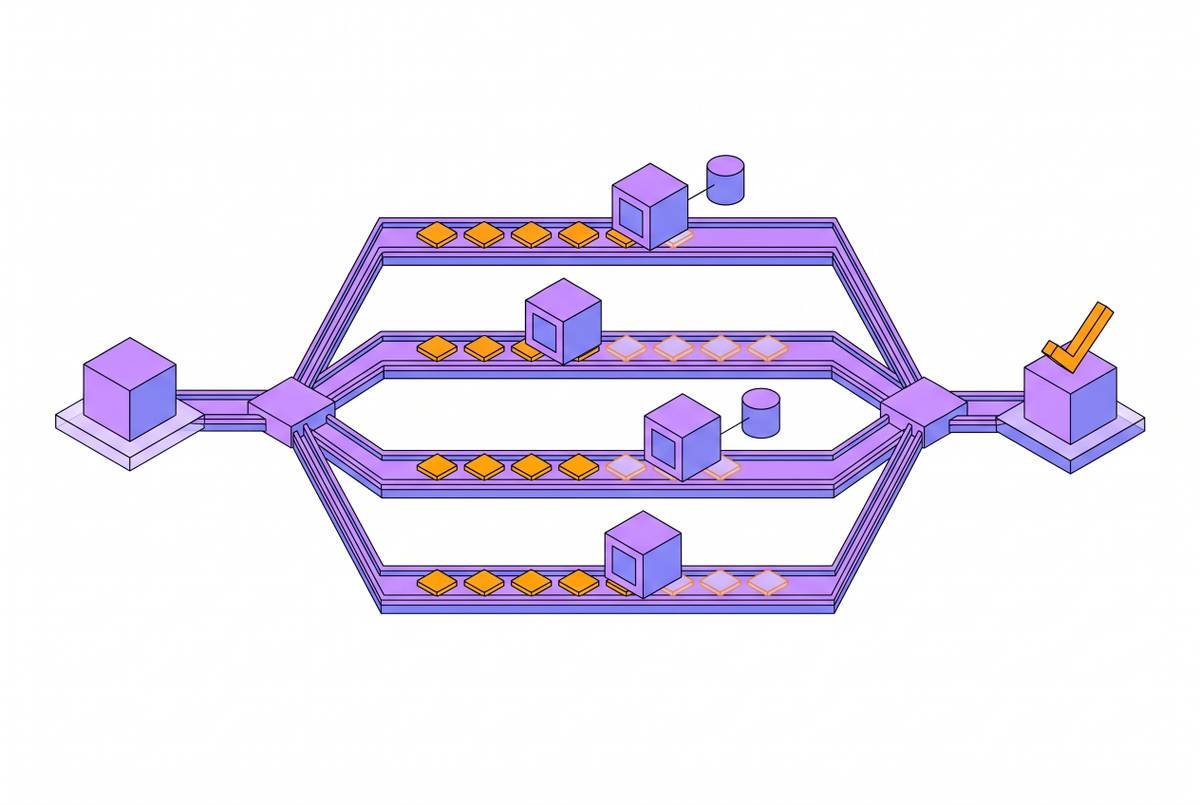
A GitHub Actions matrix distributes tests across runners, but the slowest shard determines when the suite finishes. Balanced shards make the extra runners useful. Duration-aware splitting allocates tests so that shards finish in roughly equal time, rather than leaving one runner working after the others finish. For Python, pytest-split tracks individual test durations to support this allocation. Linting, unit tests, and build checks can also be split from one sequential job across separate runners.
To keep costs down, teams need to watch for work that each of those runners repeats. Warm caches prevent each shard from paying the full setup cost, while canceling older runs when a new commit lands on the same branch avoids spending on superseded work. Billing granularity also needs measurement because splitting changes individual job durations. Raw parallelism can increase spend. Caching reduces repeated work, while parallelism primarily reduces the time developers and agents wait for a verdict.
Selective test execution at high PR frequency: when path filtering helps and when it misleads
Selective execution addresses a different question from runner speed or parallelism. It asks which work a change requires. Path filtering through paths-ignore or a changes-detection job can avoid unnecessary CI for documentation-only commits and unrelated package checks in a monorepo. The dorny/paths-filter action matches changed files against team-defined glob filters and exposes outputs for conditional execution. That approach is useful when change boundaries are predictable.
Agent-authored changes can cross those boundaries more often. When a PR touches more than one package, fewer checks can be skipped, but teams still need to keep the filters up to date. Required checks also create a branch-protection trap. A filtered workflow can leave the expected status absent and block merging. The recommended pattern is a single synthetic gate named ci-ok, with every real test job included in its needs dependencies and skipped jobs handled so the gate resolves correctly. Branch protection then requires that single check, and each new test job must join the dependency list in the same PR.
Selecting tests from the code itself, by working out which tests a change can reach, avoids manually maintained path heuristics. When reachability cannot be established, a sound selector runs more tests, not fewer. The requirement remains the same verdict. Reduced execution is useful only when uncertainty does not become an assumption that the change is irrelevant. Graphide CI does not select tests: on its runners, every test a job runs today still runs.
Securing agent-written CI configuration during and after migration
Agents can generate CI configuration quickly without providing provenance signals for the patterns they reproduce. An insecure workflow pattern can therefore spread across repositories before it is noticed. Untrusted issue bodies, PR descriptions, and comments can also shape what agents do inside GitHub Actions. Faster execution does not resolve that exposure. The same automation that increases throughput makes behavioral verification necessary at each stage of the PR pipeline.
Credential controls establish the first boundary. Agents running inside workflows should use the job-scoped GITHUB_TOKEN, with checkout’s persist-credentials setting set to false so the token does not remain in .git/config. Federated identity through OIDC should replace long-lived static keys stored in repository settings. Test jobs should hold no production credentials. Only the final deployment job, after the checks pass, should receive a scoped cloud role.
Verification must also remain independent of agent-authored workflow changes. A gate that runs on both pull_request and merge_group, points at repository tests, and is not authored by the agent provides a behavioral control beyond generated YAML. Graphide review adds a PR check that reports findings backed by evidence. It runs independently of CI and does not block merging on its own. Its role is to give reviewers evidence beyond a passing test status while the required gate remains in place.
The migration sequence that minimizes risk while reducing wait time
The migration should begin by profiling the existing workflow to distinguish setup time from execution time. That establishes which constraint the next change must address. Teams should then repair dependency caching and Docker layer caching on their current runners. The baseline should be a warm-cache run. Comparing that baseline with another warm-cache run prevents a provider decision from being driven by an avoidable cold start.
Next, teams should run workflows that reflect their usual work on the runner providers and runner sizes they are considering, and compare completion time and cost per job. Long test jobs can then be split through a matrix with duration-aware allocation. Every shard must be wired into ci-ok before parallelism changes a required check. Concurrency cancellation should remove superseded runs where agents submit commits in quick succession. These changes shorten feedback without treating additional runners as free compute.
Selective execution should follow where documentation changes or isolated packages provide dependable boundaries. Path-based selection needs the synthetic gate, while reachability-based selection avoids keeping glob lists up to date but needs evidence of its own. Evidence-backed review, including Graphide review as one option, then adds evidence for agent-authored changes independently of the CI verdict. At every step, failing tests must still fail jobs, and affected tests must run when reachability is uncertain.