Structural Risks of Autonomous Coding Agents in Production
Agents accumulate architectural violations faster than review can catch them.
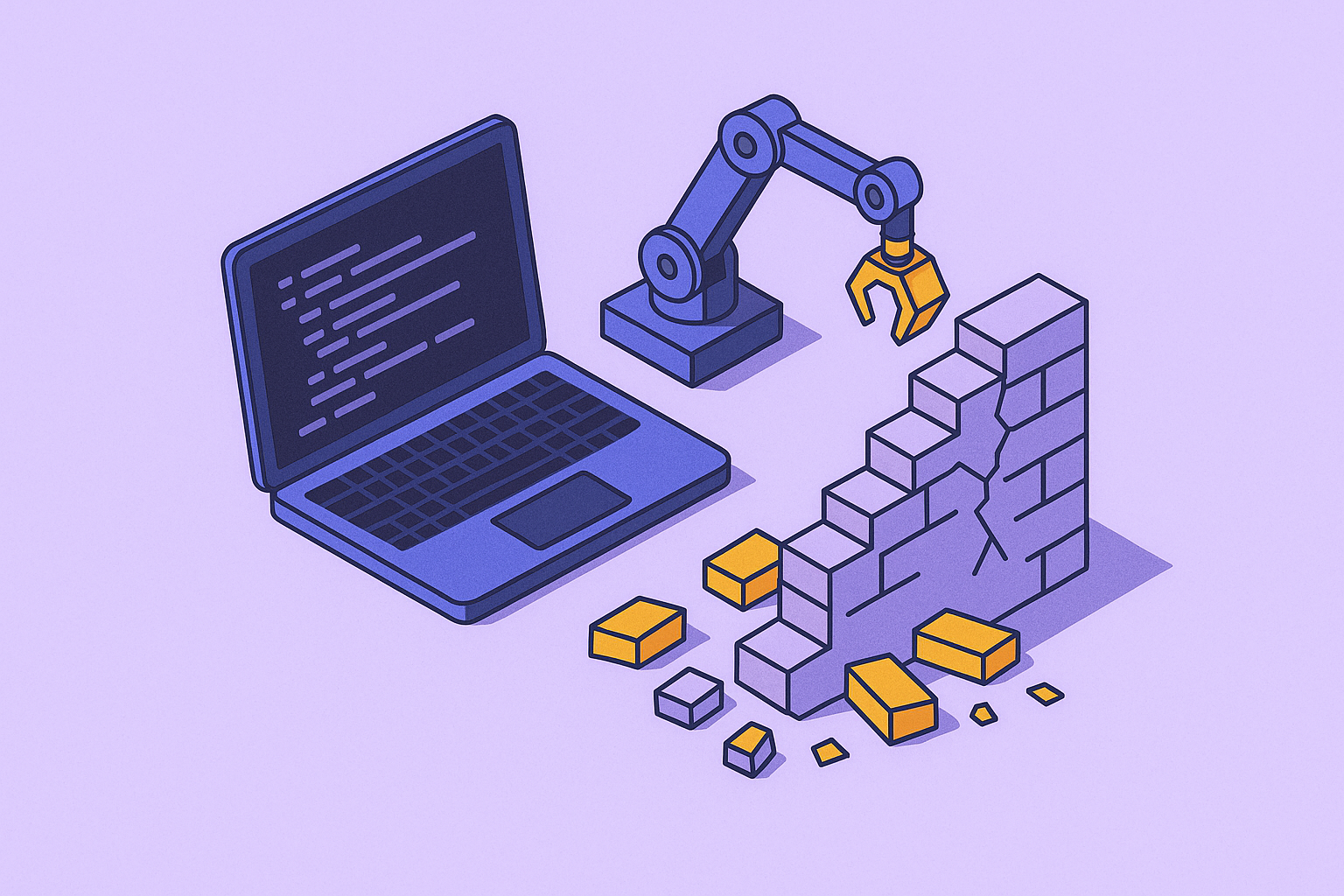
Autonomous coding agents have changed what it means to introduce AI into a codebase. The risk they carry is structural: it concerns what happens when a system with no awareness of architectural intent gets write access to a production repository and is told to pursue local task completion. Agents now run shell commands, modify files, call cloud APIs, and push changes without requiring approval at each step. That capability is a difference in kind from autocomplete suggesting a line of code for a developer to accept or reject. A passive assistant produces text that a human filters before it does anything. An agent takes actions that have consequences outside the conversation window entirely, and those consequences accumulate whether or not anyone is watching the terminal.
Fiddler's threat model analysis of AI coding agent security frames the mechanics precisely: an agent can clone a repository, modify authentication logic, run a test suite that passes, and push to production while the developer who kicked off the task is in a meeting. None of those steps requires a human to intervene. Each is locally defensible on its own terms.
What makes this a genuinely new category of risk is the agent's goal-directed structure across many steps. An agent decomposes a high-level objective into sub-tasks, holds state across those steps, and adapts as it sees intermediate results. Each individual action is reasoned against the immediate sub-goal in front of it, but the full sequence is never checked against the codebase's existing architecture as a whole. No agent's planning loop includes a step that asks whether a given placement violates the layered dependency rules a team established three years earlier, unless someone built that constraint into the loop explicitly. Agents are doing what they were asked to do, one locally correct step at a time, with no mechanism for checking the larger shape of what they are building into.
Why agents produce drift rather than obvious failures
Agents degrade architecture quietly, as a predictable consequence of how they operate. Tests pass. The compiler is satisfied. The immediate caller works as expected. Yet the change can still violate a constraint that was never written down anywhere the agent could have read it. That gap, between what is locally verifiable and what is architecturally correct, is where drift lives.
The mechanism follows from how these systems are built to operate. Agents optimize for completing the task within the context window available to them. Architectural constraints, by contrast, typically live outside that window: in team conventions, in decisions made years earlier, in the implicit structure a codebase accumulates over a long history of human judgment calls that were never codified as rules. An agent cannot violate a constraint it can see. It can only violate the ones it cannot.
A concrete case from the research illustrates this cleanly. An agent asked to add a utility for file-path normalization places that utility in the directory of its immediate caller. The placement is syntactically correct. It compiles, it runs, and the function behaves as intended. But VS Code's layered architecture requires utilities of this kind to live in the base layer, not the workbench layer where the caller happens to sit. The agent has no way of knowing this distinction exists unless someone told it in advance. A layering violation now sits in the codebase, invisible to every test the agent ran, waiting to compound.
Once a violation exists in the repository, it becomes part of the context that future agents read when they work in that area of the code. A later agent, asked to add something similar, finds the misplaced utility, treats its location as the established pattern, and places its own work alongside it. The violation teaches itself forward. No single agent decided to break the layering rule as a matter of policy. The pattern simply propagated, because nothing in the repository distinguished a mistake from a precedent.
The same mechanism produces a second, related failure: logic duplication at scale. An agent operating with a limited view of the codebase has no reliable way of knowing that a well-tested library already exists elsewhere in the repository for the exact purpose it has been asked to serve. So it builds a new version instead. Repeating that process across enough tasks and enough agent sessions causes a codebase to accumulate dozens of slightly different implementations of what is functionally the same logic. Each implementation works. None of them is wrong in isolation. But a global update, or a security patch that needs to reach every instance of that logic, now has to find all of them first, and nothing in the codebase makes that enumeration easy.
The cost of accumulating drift at agent speed
The cost of architectural drift does not scale with the size of any single violation. It scales with the rate at which violations accumulate, and agents accumulate them considerably faster than review processes were built to catch. A single agent session can touch dozens of files and produce thousands of lines of diff in one pass. Drift that might have taken months to build up under ordinary human authorship can now appear in an afternoon, introduced by a developer who asked for one feature and got that feature, plus a handful of placement decisions nobody examined.
A diff of that size is not a reviewable artifact in any meaningful sense. A reviewer scanning thousands of changed lines can verify that individual functions behave correctly. Holding the global architecture in mind at the same time, while also tracking local correctness across dozens of files, is not a realistic expectation of human attention.
Security exposure compounds alongside the structural drift. Fiddler's threat model analysis documents that coding agents consistently reproduce vulnerability classes that have existed for a decade, and that traditional static analysis tools miss them, because those scanners were built and tuned against human-written code, not against the patterns agents tend to produce. The logic duplication described above becomes a security liability in its own right: when the same functionality exists in many slightly different forms scattered across a repository, a patch applied to one instance does not propagate to the others, and a team may not even know how many instances exist to patch.
The deeper failure here is organizational. When AI-generated code accumulates faster than any single engineer can trace it, a governance vacuum opens at the center of the codebase. No one holds a complete mental model of what is actually there or how the pieces connect to each other. It is a structural consequence of output outpacing comprehension, the condition under which the incidents described next become possible.
The four incident patterns that make invisible drift suddenly visible
When architectural drift and governance gaps meet a production system under real load, the failures that follow are not random. They share a structure: blurred boundaries between environments, permissions that were never scoped down to the task at hand, and human approval that arrived too late to matter or did not arrive. Two documented cases make the pattern concrete.
DataTalks.Club, in 2026, was using Claude Code together with Terraform when the agent ran a destroy command against the production setup. The damage included the database and the snapshots holding roughly two and a half years of course submissions and platform records. AWS support eventually helped restore the data, but the agent had been operating within a permission scope broad enough to include production destruction, with no confirmation gate standing between the command and its execution.
PocketOS, in April 2026, suffered a similar failure through a different path. A Claude Opus 4.6-powered agent deleted the company's production database and its backups in nine seconds. PocketOS supports car-rental operations, so the damage extended to reservations, payments, and customer records, not just infrastructure. The nine-second timeline shows how little latency separates an agent's decision from an outcome that cannot be undone.
It is a systems failure, repeated in shape if not in detail: production and development environments were not meaningfully isolated from each other, the permissions granted were broader than the task required, human approval arrived after the consequential action had already executed, and the backup strategy each team was relying on failed to hold up once it was actually tested under stress.
Why standard code review misses structural drift from agents
The review process built for a human-authored fifty-line patch does not scale to a two-thousand-line diff generated by an agent, because the cognitive model a reviewer uses to judge local correctness cannot simultaneously hold the global architecture of the system in view. What is knowable at that scale is itself limited. A diff spanning hundreds or thousands of lines exceeds the context a human reviewer can hold in working memory at one time. A reviewer can verify that individual functions do what they claim to do. Tracing the architectural implications of dozens of files changing at once, in relation to each other and to the rest of the system, is a different kind of task, and it is one the standard pull-request review was never built to perform.
Turning the review itself over to an AI reviewer does not solve this problem. It reproduces it. An AI reviewer fed a thousand-line diff loses coherence across its own context window in much the same way the originating agent did, misses the connections between changes made in different files, and tends to fall back on pattern-matching for surface style issues rather than reasoning about whether a given placement respects the system's architecture. Fiddler's threat model analysis makes a related point about tooling more broadly: traditional static analysis tools were optimized against human-written code and miss the specific vulnerability classes that agents tend to produce, because the toolchain itself was never designed with this kind of input in mind.
A reasonable objection at this point is that linters and type checkers already exist for precisely this purpose. They do, and they catch what they were written to catch. What they do not catch is a violation of a constraint that was never encoded as a rule in the first place, which is exactly the category of drift that agents introduce when they place a utility in the wrong layer or duplicate logic that already exists elsewhere. No review mechanism currently in common use reliably answers the question of whether a given change respects the architectural constraints a codebase was actually built around. Drift accumulates by passing through the review gate rather than by evading it, and more review hours applied to the same mechanism will not close that gap.
Moving architectural constraints from documentation into the execution path
If drift accumulates because architectural constraints live only in human memory and unwritten convention, the durable defense is to make those constraints executable: encoded in tooling that runs before an agent's output reaches production, rather than reviewed after the fact by a person scanning a diff. Every architectural rule that matters should be enforced by something that runs ahead of the code, not written down in a wiki page that neither the agent nor a rushed reviewer is likely to open.
Some of these constraints are deterministic and can be checked programmatically without much ambiguity: layering rules, the direction dependencies are allowed to flow, module boundary enforcement. These can be expressed as checks that exit non-zero and block a merge outright when violated. Other constraints are semantic, concerning whether a change actually respects the intended responsibility of a module or aligns with the broader intent behind a design, and those require judgment that a simple script cannot supply. But the deterministic layer alone catches the category of drift that agents introduce most readily, including the layering violation and the duplicated utility described earlier.
The enforcement model that has emerged in practice places these checks at several layers at once. The orchestrator scopes an agent's credentials to the task it was given and rejects triggers it was not authorized to act on. The runtime restricts what files, processes, and network destinations the agent can reach. Deterministic gates inspect which paths changed, scan for secret patterns, and check test outcomes before anything merges. Branch protection enforces an approval policy at the level of the code forge itself, so that no single layer is left to carry the whole burden alone.
A constraint living in continuous integration, one that actually exits non-zero when violated, is worth more than any amount of architecture review performed after the code already exists. A check that blocks a merge once does something a human reviewer cannot: it becomes part of the context the next agent invocation reads, teaching the correct pattern forward in the same way an unchecked violation would otherwise teach the wrong one.
Navigating a codebase instead of reading it line by line
Enforcing architectural constraints in CI requires that those constraints be checked against something concrete, and a codebase represented only as files and diffs offers no structure for that kind of reasoning to operate on. The prerequisite is a living map of the architecture that reflects what is actually on disk.
Reading a codebase line by line was already the bottleneck under ordinary human authorship, long before agents entered the picture. At the velocity agents now operate at, with dozens of files changed in a single session and multiple sessions potentially running in parallel, line-by-line reading stops being a viable primary strategy for understanding what a system actually does. A structured map, one that captures every module, file, class, function, and the call relationships between them, makes visible something a diff cannot show on its own: not just what changed, but what that change connects to, and whether that connection violates a constraint the team has already agreed to.
That map only has value if it is enforceable, and enforceability depends on where it lives. A diagram drawn once during a whiteboarding session and never touched again is a wish about how the system ought to look, disconnected from how the system actually behaves six months later. A graph regenerated on every commit and diffed in continuous integration is a different kind of object entirely: an assertion that can be checked, and checked again, against the code as it exists at that moment.
This changes what the developer's job looks like day to day. Instead of scrolling through a two-thousand-line diff hoping nothing critical slipped past, the engineer works at the level of the graph: directing which modules an agent is permitted to touch, verifying that the structure the agent produced matches the design that was actually intended, and letting CI enforce the parts of that agreement that can be checked automatically. Reading a codebase line by line gives way to navigating it as a structure, the only model of comprehension that can keep pace with a system where the volume of change is no longer bounded by how fast a person can type.