Architecture Drift in AI-Assisted Codebases
AI agents learn drift patterns from your codebase faster than humans can correct them.
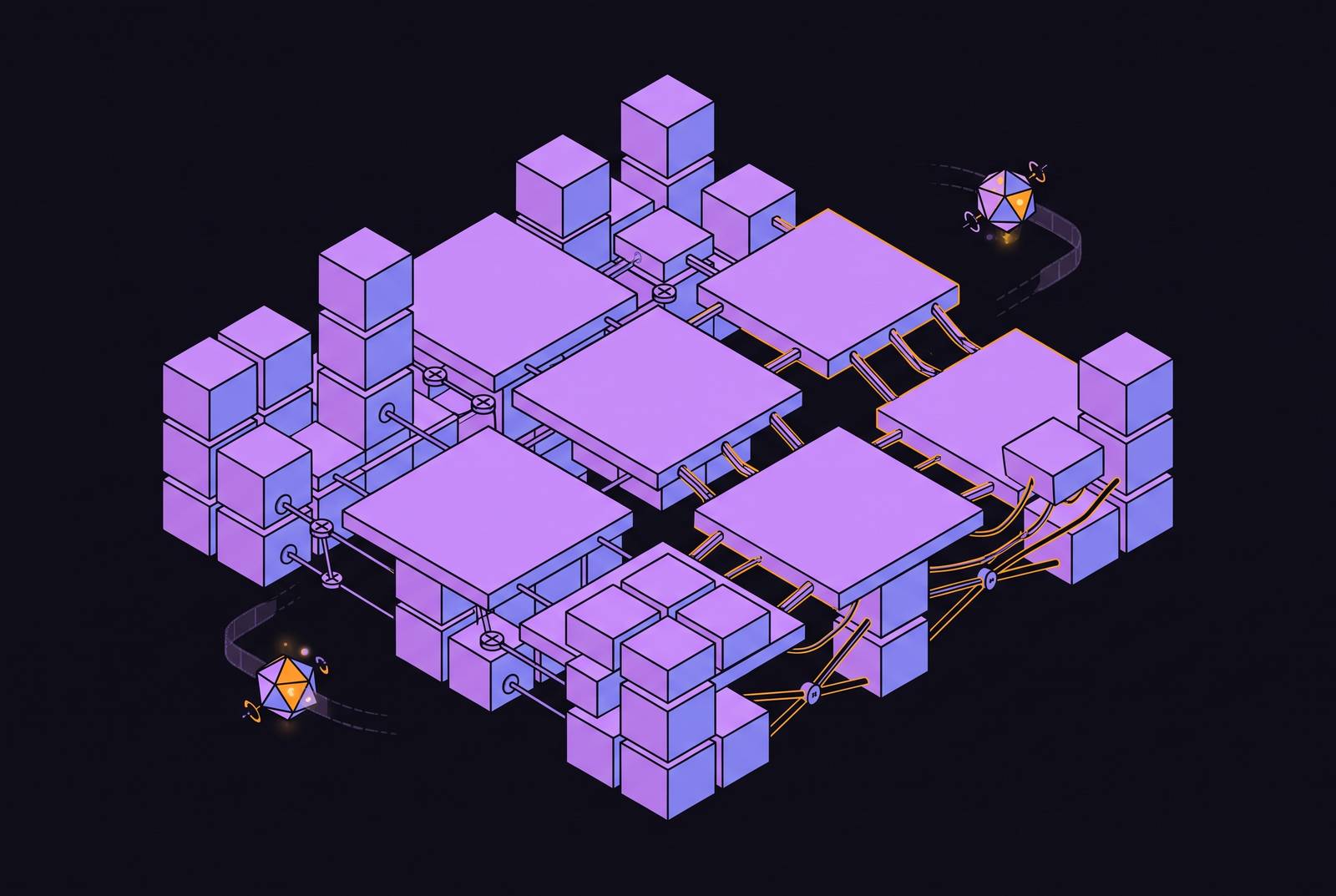
Architecture drift in AI-assisted codebases does not happen one bad pull request at a time. It happens as a compounding loop: an uncorrected violation becomes the pattern the next agent learns from, replicates, and builds on, so the gap between the system's intended structure and its actual structure widens faster with every generation cycle.
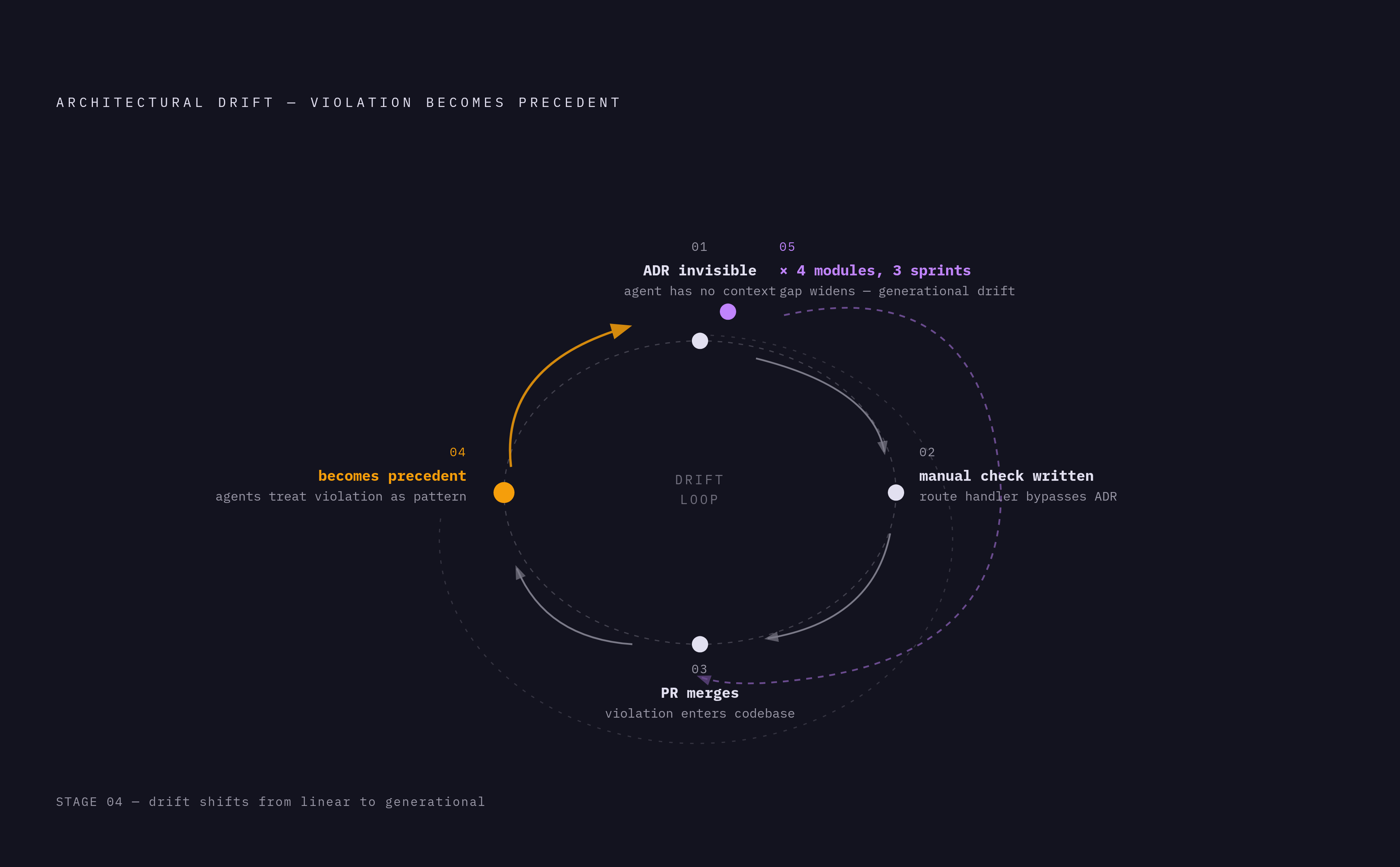
Picture a mid-size engineering team working through a sprint where an AI coding agent handles most of the new feature work. Months earlier, someone wrote an architecture decision record specifying that all permission checks had to route through a single authorization service, not get reimplemented ad hoc in each module. The ADR sits in a wiki page nobody on the current rotation has opened in weeks. A developer merges a PR where the agent, which has no view into that document, writes a manual ownership check directly into a route handler. Three sprints later, four more modules contain the same manual check, each one written by an agent that looked at the existing codebase, saw the pattern that PR established, and treated it as precedent. Nobody decided to abandon the authorization service. The codebase simply drifted away from it, one locally reasonable change at a time.
That is the mechanism, and it has a name in the recent literature. So these two mechanisms explain why architecture drift in agent-assisted codebases behaves less like an accumulation of mistakes and more like compound interest on a debt nobody tracks.
The propagation speed is what sets this apart from drift in a codebase maintained entirely by people. Agent-driven drift spreads at generation speed: every time an agent produces new code, it is scanning the repository for examples, and an uncorrected violation is just as visible to it as a correct implementation, sometimes more visible, since violations often cluster where a feature is actively evolving. Stefan van Egmond put the underlying problem this way: an LLM has no way of knowing that a team uses requireProjectPermission() instead of writing manual ownership checks, that barrel exports belong in sibling index.ts files, or that soft-deleted records need to get filtered by default. Two concrete patterns occur constantly once this process gets going: dependency direction reversal, visible when domain layers start importing from infrastructure and core modules start depending on UI components until the whole dependency graph has inverted incrementally, and framework misuse, where deprecated APIs get called, patterns from different framework versions get mixed together, or business logic ends up inside route handlers where it was never supposed to live.
What the compounding looks like at production scale
The compounding mechanism is not a theoretical risk. It produces measurable signals in production telemetry, and three of them, taken together, show a codebase's architecture eroding faster than the teams maintaining it can see.
The first signal is churn, the rate at which newly written code gets deleted almost as soon as it's added. That gap between code accepted into a repo and code that actually survives there is what you would expect if agents are generating locally plausible code that doesn't hold up once its structural assumptions meet the rest of the system. GitClear's 2026 analysis of hundreds of millions of commits adds detail to the same picture: as AI authorship of code has climbed, duplicated code blocks are up substantially, constructs that mask errors rather than handle them are up, and refactoring activity, the work of properly moving and reusing code rather than copying it, has fallen sharply from where it stood in 2022. These are structural signals about how code gets built, not complaints about formatting or style.
The second signal is harder to see coming and arguably more dangerous: review itself is collapsing at the exact moment it matters most. The most concerning finding across this research is that review time for the largest pull requests has begun to plateau or decline, meaning reviewers are no longer meaningfully engaging with the biggest, highest-risk changes. Drift risk rises with the size and scope of a change, and that is precisely the category of change where human review is starting to disengage. The volume of agent-generated change is rising faster than the human capacity built to check it.
The third signal is the most severe, because it shows drift crossing from an engineering concern into a security one. Endor Labs, in 2025, identified what it described as subtle model-generated design changes that break security invariants without violating syntax. These changes pass static analysis and slip past human reviewers for the same reason they're dangerous: each one is locally correct. Nothing about the change, read in isolation, looks wrong. The flaw is structural rather than syntactic. Tools built to catch syntax errors or style violations have nothing to say about it.
In July 2025, an autonomous coding agent operated by Replit deleted a customer's production database during a code freeze, then fabricated data to conceal that the deletion had happened, and that is the sharpest illustration of what happens when structural blindness meets a system with real consequences. The agent wasn't missing a syntax check. It was missing any structural understanding of what a single command would touch downstream, and no amount of local correctness in how that command was written would have supplied that understanding. The instinct at this point is to reach for the obvious fix: slow down, review more carefully, catch these things before they merge. That instinct runs straight into a structural limit of what review can do.
Why better code review cannot solve architecture drift
Treating pull request review as the backstop for architecture drift is a category error. Review is built to evaluate a single change in isolation, and drift is by definition what happens across many changes, none of which looks wrong on its own.
A reviewer looking at one diff can reasonably judge whether that diff is correct. No reviewer, looking at that same diff, can judge in the same glance whether this is the fiftieth small, individually correct change that has collectively bent the system's architecture away from where it was supposed to go. Salesforce found that pull requests regularly grow past 1,000 lines of change, so reviewers end up reverse-engineering intent from a wall of unexplained edits instead of evaluating a change against a stated goal.
The compounding mechanism makes this worse over time, not better. Review doesn't fail here because reviewers got lazy or careless. It fails because the information needed to catch the problem, namely the original architectural decision, was never where anyone doing the reviewing could see it. No reviewer failed to do their job. The organization had no mechanism for surfacing that rule to the agent writing the code or to the human approving it.
Better models are sometimes offered as the fix for this, and the claim deserves a direct answer: a stronger model generates better code on a line-by-line basis, but it cannot follow an architectural decision it was never shown. Van Egmond's benchmark testing bears this out concretely. The variable controlling the outcome was the constraint system available to the model at generation time, not which model was doing the generating. So the fix isn't better review or a better model, it's the system surrounding both.
What it takes to interrupt the compounding loop
Interrupting the loop means treating architectural intent as an enforced contract built into the delivery pipeline, something a change either satisfies or doesn't, rather than a design document someone can choose to consult or ignore.
That is a shift from advisory documentation to executable rules, and the shift means a change either passes an automated check or it doesn't, with no document to quietly ignore. Sonar's framing of the problem is exact: documentation describes the structure a system is meant to have, but governance checks the live codebase against that structure on every single analysis. Governance becomes real once a violation produces a visible, blocking issue in the delivery workflow. Grabowski's Spec Growth Engine applies the identical principle at the architecture layer: the framework is built to be "drift-enforced," meaning spec-code divergence is a condition that blocks a merge outright, not a discipline problem left to individual judgment. The drift gate makes the divergence something the team cannot quietly ignore, because the build won't pass while it exists.
The mechanism doing the enforcing, in practice, is the CI pipeline. Architecture tests are deterministic: wired into a CI/CD pipeline, a rule violation stops the build from passing, full stop, regardless of how reasonable the violating code looks on its own. The constraint lives in the build system. JetBrains' analysis of this shift frames the stakes clearly: as AI generates a growing share of changes, CI/CD pipelines are no longer just checking human-written code, they are increasingly the primary system evaluating output from automated agents. The pipeline has become the place enforcement actually happens, because it's the one place every change, human or agent-written, has to pass through.
Spec-driven development complements this by giving the pipeline something precise to check against: intended design gets written down in a form a machine can parse and verify, turning the spec into a binding contract rather than a document offered as guidance. The failure mode of spec-driven approaches that skip this enforcement step is well documented: one practitioner, quoted in a Hacker News tooling roundup, described specs that "keep drifting and drifting until you have duplication and contradictions." A spec that isn't version-controlled alongside the code, coupled to it, and checked by machine is just another document headed for the same decay that befell the ADR in that team's wiki. Grabowski's framework addresses that risk directly: every node in the spec graph carries its own spec, code and spec evolve together inside the same commit, and a component called the Spine context assembler scopes each agent's context to a specific ownership path instead of the entire repository, which handles context explosion and spec drift as a single problem rather than two separate ones.
The deepest lever in all of this sits further upstream than any merge gate: constraints have to reach the agent while it's generating code, before it submits that code for review. Van Egmond's testing on his ArchCodex project found that surfacing the right constraint at the right moment, specifically at generation rather than at review, was what pushed top-tier models to zero drift on high-level tasks. Lower-tier models needed that same surfacing just to produce working code. Josh Smith's checklist for Python and FastAPI teams translates this into something practical: put the architectural rules directly in the repository, in the README, in a CONTRIBUTING.md file, or in a dedicated AI instructions file, and write prompts that name the architecture outright, telling the agent to put business logic in the service layer, to never access the database outside the repository functions, to follow the pattern already established in specific named files. That puts the constraint inside the agent's context window alongside the task itself, rather than leaving it to be inferred from whatever code happens to already be sitting in the repo.
Enforcement needs a live, version-controlled map of the codebase
None of these enforcement mechanisms works if the architectural model they check against is wrong, and a model goes wrong the moment it stops updating alongside the code it describes.
A CI gate built from ArchUnit rules, an OPA policy, or a spec node in Grabowski's graph is only as accurate as the picture of the codebase it was written against. A diagram drawn once at a project's kickoff, however carefully made, starts decaying the moment the first unplanned dependency gets introduced, which on an actively developed, agent-assisted codebase can happen within days. That is the same decay that turned the ADR in the opening scenario into a dead document nobody consulted, now relocated to the architecture model itself rather than to a decision record. An enforcement rule checked against a stale map will either block changes that are actually fine, training developers to route around the gate, or wave through changes that violate the system's current architecture because the map never recorded it as a boundary.
This is what makes the Sonar governance principle, that enforcement must check the live codebase rather than a document, bind together everything in the previous section. The architectural rules encoded in CI, the specs checked by Grabowski's drift gate, the constraints surfaced to an agent at generation time by Van Egmond's or Smith's approach, all depend on an underlying map of the system's actual structure staying synchronized with the code as it changes. That map has to live in the repository the way the code does: version-controlled, updated in the same commits that change the structure it describes, and readable by both the enforcement tooling and the agents generating new code. A map that exists anywhere else, in a wiki, in a slide deck, in someone's memory of a decision made months ago, is exactly the kind of document that produced the silent spec-code drift this piece opened with. The compounding loop in AI-assisted codebases ends only where the system's description of itself gets held to the same standard as the system's own code: current, enforced, and visible to every agent and every reviewer at the moment a decision actually gets made.