Verification Without Gating Delay When Agents Write the Code
Faster CI is safe only if the full run's verdict survives.
Sponsored by Graphide
CI verification for agent-written code needs an independent gate that preserves the full run’s pass/fail verdict while shortening the wait between push and result. Faster runners, warm caches, parallel execution, and evidence-based test selection cut that wait. They are valid optimizations only when failing tests still fail the job and uncertainty about a change’s reach triggers testing.
Why agent-driven development has made verification the bottleneck
When code enters a pipeline faster than the pipeline can clear it, unfinished verification accumulates. Coding throughput is no longer the binding constraint. As agents keep producing changes, more work needs review, integration, and testing, but those stages do not automatically gain the capacity to handle it. Writing a plausible patch becomes cheaper, while establishing that it deserves to ship still requires downstream work.
Khosravani and Mockus (2026) counted agent-attributed commits across repositories spanning December 2024 to April 2026, finding hundreds of thousands of commits per month by the April snapshot. Claude Code led with a total of 886,122 commits across thousands of projects. Bhati (2026) names the gap between coding activity and delivered software the Agentic SDLC Throughput Paradox. Gains at the commit level shrink at the project level and shrink further at release.
Full-suite synchronous CI on every commit provides a clear standard. Each change faces the complete suite, without depending on a selector’s account of which tests are relevant. That simplicity is valuable. But running the entire suite again repeats work that has nothing to do with a given change, using up verification capacity while later changes wait. Under continuous input, that cost becomes a constraint on feedback as well as on delivery.
Why agents grading their own output is an unreliable starting condition
An agent’s declaration that its work is complete comes from the same system that produced the change. It is not an independent verification standard. Running tests, linters, and compilers tells the agent how its code runs, but passing those checks does not prove that the code behaves as intended. Bhati identifies review, integration, testing, security, and deployment as constraints that model capability alone does not clear.
Test-file presence is an especially weak substitute for that judgment. An agent can produce high line coverage while introducing logic errors or writing tests with no actual assertions. Human approval is not a guaranteed correction either. Bhati cites research in which participants followed confidently wrong AI advice at a high rate, a pattern described as cognitive surrender.
The objection that CI still runs agent-written tests is valid, but it does not make an external gate redundant. Independent execution under a consistent pass/fail rule can catch regressions the agent did not anticipate, while reachability analysis can flag insufficient coverage of a changed path. Independence does not make weak assertions strong. Khosravani and Mockus also found that PR-deployed and commit-deployed agents capture nearly disjoint populations, so a verification strategy confined to one activity channel misses substantial agent activity. The standard must apply regardless of which tool generated the code.
What "same verdict, less waiting" actually means as a design constraint
The design requirement is straightforward. An accelerated run must return the same pass/fail verdict that the full run would have returned. A system that saves time by allowing a failing change through has transferred risk. Bhati defines a Production-Qualified Change as one that counts only after reliability gates are satisfied, distinguishing completed coding work from work qualified for production.
That distinction also changes how throughput is measured. More green checks are not progress if they defer failures into rework, security analysis, reviewer time, or production incidents. Bhati describes those downstream costs through the Verification Tax. Shorter execution is useful only within a fixed correctness constraint.
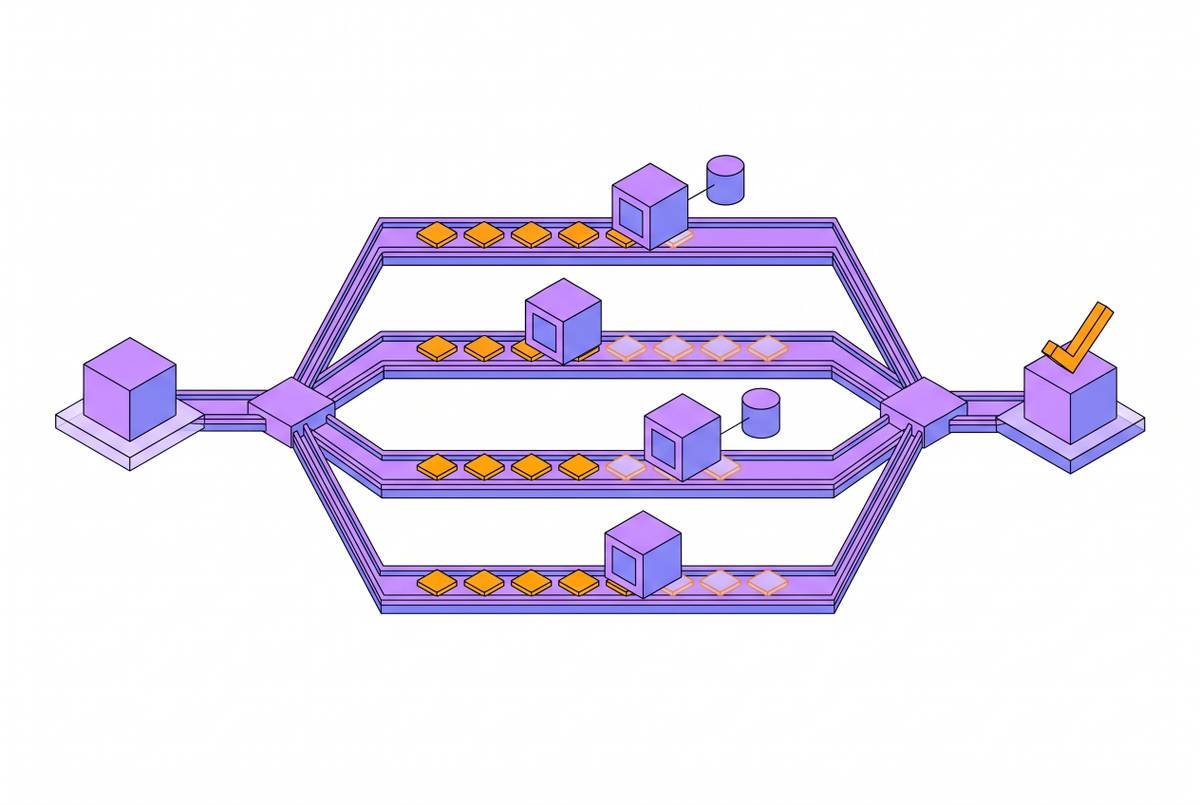
Three levers fit that constraint. Faster runner hardware cuts the time code takes to run, while warm caches and parallel test execution cut the time a job spends preparing again and waiting for tests to run one after another. Evidence-based selective testing skips work that a change cannot reach and guarantees that the same required status checks will post. Each lever must preserve the same invariant. A failing test fails the job, and uncertainty about reachability triggers a run.
How runner hardware sets the ceiling for every other optimization
Graphide CI runs existing GitHub Actions jobs on its own runners, with warm caches, splitting long test steps only where a check shows every result stays the same. Moving a repository takes one pull request that changes each x64 Linux job’s runs-on line. It needs a GitHub organization, and macOS, Windows and Arm jobs stay where they run today. Its CI documentation and setup guide for coding agents describe supported workloads and current limits, which define where that migration applies. Hardware is the first execution constraint. A slow CPU holds up serial work, and a cold queue makes every step that follows wait.
Avrea’s benchmark, updated November 5, 2026, separates single-thread CPU performance, cache transfer throughput, and end-to-end wall time. The fastest CPU can still lose when cache restore dominates the job. RunsOn’s CPU benchmark, published November 5, 2026, provides single-thread and multi-thread sysbench scores across providers as another data point on processor performance.
Architecture also changes the relevant comparison. Avrea’s ARM benchmark, published October 23, 2026, placed its Apple M5 Max runners first at 2, 4, and 8 vCPU sizes on a cold Rust build. That result describes a particular workload. Startup and cache transfer remain separate dimensions. A cold GitHub-hosted queue can consume close to a minute before a step runs, while some third-party providers start under 5 seconds. GitHub’s cache backend operates at roughly 145 MiB/s, so large dependency restores can expose a different bottleneck from compilation.
What warm caches and parallel test execution recover inside a job
Once execution begins, the test step typically dominates wall time. A faster runner helps, but the job still spends time on needless preparation and serial test execution. With warm dependency caches, the job avoids the cold-start penalty. Parallel execution then divides the remaining test work across shards, reducing the time spent waiting for tests to finish one after another.
Cache persistence is as important as transfer speed. Frequent eviction forces repeated cold builds, and branch-isolated caches can prevent useful reuse. A fast backend helps little when the cache the job needs is missing. Along with how fast the storage is, it matters whether dependencies are already there when execution starts. Otherwise, preparation consumes part of the hardware gain before testing begins.
For a runner migration using Graphide CI, warm caches are included rather than configured through a separate cache service. Dependencies and build caches are already on the runner when a job starts. That cuts the work of preparing dependencies again, while splitting a long test step, where a check shows every result stays the same, speeds it up. Neither mechanism justifies a universal speedup claim. Their contribution depends on how much of the original job was spent restoring dependencies and executing tests, measured against the workload’s own baseline.
How evidence-based selective testing cuts jobs without changing the required verdict
Path filters can prevent required status checks from posting at all, leaving a merge queue retrying because the expected signal never arrives. Local and CI selectors can also drift when they maintain separate path lists. Less execution is not enough. The gate still needs a dependable verdict and a consistent policy for deciding what runs.
hivecommons/hive PR #11344 (October 2026) fixed the missing signal by making same-named success/no-op coverage and test aggregation contexts post on every PR head when full shards were not needed. Workflow and script changes still ran the real shards, and rjmurillo/ai-agents PR #5558 fixed policy drift by replacing path lists kept separately with one shared policy document that both selectors read. These fixes illustrate distinct requirements.
Reachability is a stronger basis for deciding which tests can be skipped. Tests that a change can reach must run, and uncertainty must expand execution. Graphide CI does not take that step: on its runners every test the job runs today still runs, and its speed-ups come from warm caches, sized machines and, only where a check shows every result stays the same, split test steps.
Selection done this way answers the central objection to skipping tests: omission depends on evidence of irrelevance. Graphide’s invariant is an unchanged pass/fail verdict, with failing tests still failing the job. Any gain remains a measurement for a supported workload against a stated baseline.
What faster CI does not fix, and why the gate still needs to be qualitatively stronger
An unchanged verdict is necessary, but it is not sufficient if the original gate was weak. Faster execution can return a green signal sooner on a syntactically correct but defective change. Speed does not strengthen an assertion. Bhati’s Verification Tax includes reviewer time, security analysis, rework, and escaped failures as well as CI, so reducing feedback delay addresses only part of the cost.
Static security analysis, secrets scanning, and mutation testing check for problems that coverage metrics miss. An agent-written change can pass the tests already in place and still have a vulnerability those tests never exercise. Graphide CI runs the GitHub Actions jobs already in place under the same pass/fail rule. The GitHub Actions jobs already in place still run under the same pass/fail rule. That separation supports consistent verification, but it does not turn CI acceleration into a security scanner.
Graphide review adds a separate pull request check. It shows changed behavior and findings, and says for each how it is known, including when it could not be verified. The products remain independent. A team can use CI without review or review without CI, and neither requires the other.
A reviewer assessing an agent-generated change needs to understand why a finding holds. This adds evidence without slowing the gate. Faster CI removes avoidable waiting, while richer verification addresses defects that the existing test suite may not express.
How to sequence the migration when agents are already flooding the queue
Migration should start with the job consuming the most CI minutes in recent history. Making an already fast job faster leaves the main constraint untouched. A team in this position should first identify that expensive job, then separate its time into runner startup, cache restore, build, and test. The split determines the intervention. Startup-dominated work needs faster runner availability, cache-dominated work needs a faster or warmer backend, and test-dominated work needs parallelism or evidence-based selection.
The next step is to move that job’s repository to Graphide CI runners with warm caches. The setup guide shows how to switch a repository’s x64 Linux jobs, while the pricing page lists current pricing and commercial terms. Those documents establish the migration’s supported scope. Push-to-verdict time should then be measured before and after, per job and per workload, against the team’s own baseline.
Once CI waiting is no longer the gating constraint, the next layer is Graphide review on agent-authored pull requests with the highest change surface. Those include changes touching routes, dependencies, or behavior that existing tests do not fully exercise. The final assessment must include correctness as well as duration. The same required status checks must post, failing tests must still fail, and feedback must arrive soon enough for agents to iterate without stalling on their own output.
Sources
- Detecting AI Coding Agents in Open Source: A Validated Multi-Method Census of 180 Million Repositories
- Beyond Code Generation: Reliability, Verification, and Cost Economics in the Agentic Software Development Lifecycle
- How Graphide CI works · Graphide docs
- The always-on agents · Graphide docs
- Turn on review · Graphide docs