What changes, and what stays, when a team moves its GitHub Actions jobs to Graphide CI
Only each job's runs-on line changes, and GitHub still decides pass or fail.
Sponsored by Graphide
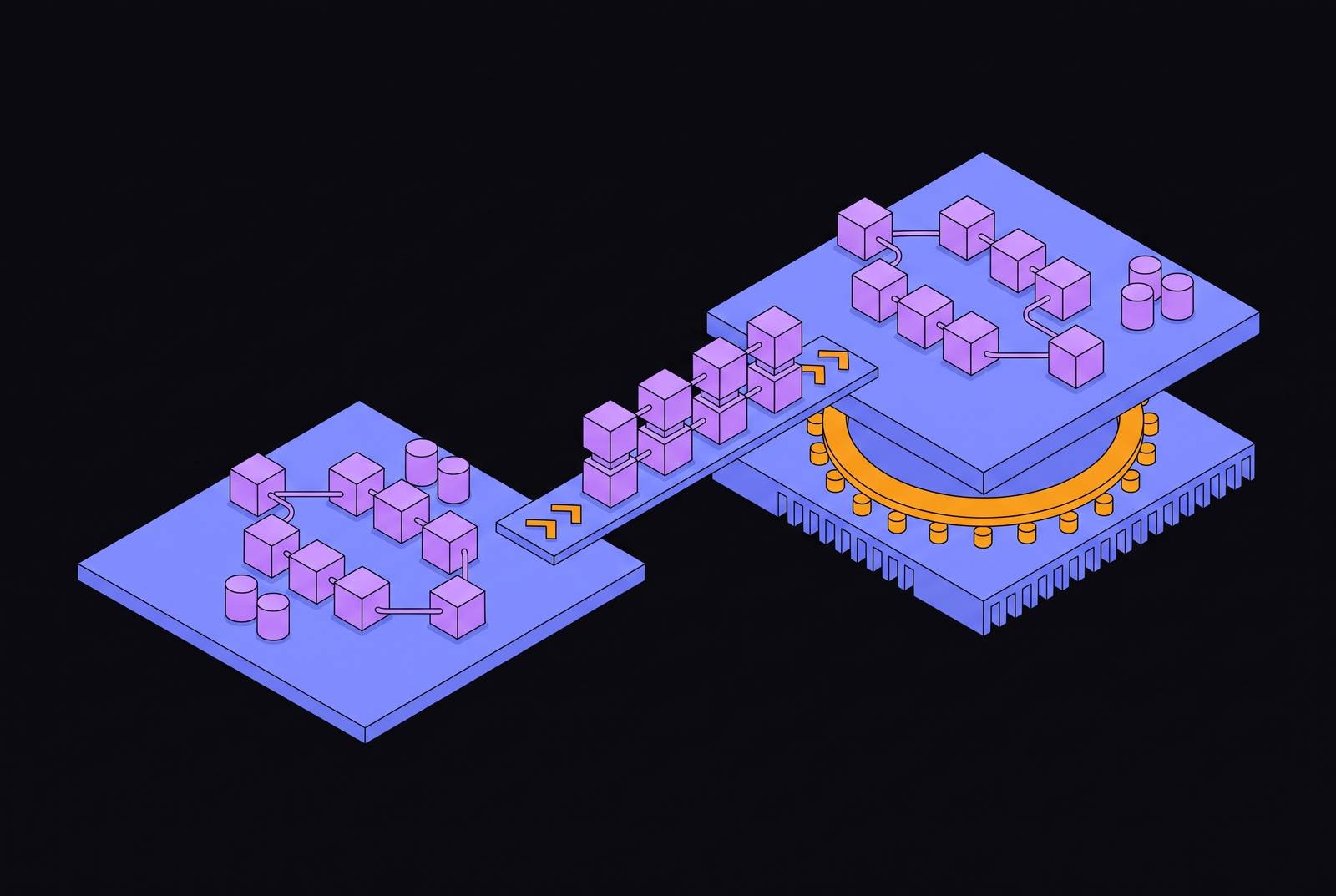
Moving GitHub Actions jobs to Graphide changes where eligible jobs run while leaving decisions about whether they pass in the same hands. The workflow edit is the runs-on label of each moved job. Commands, tests and checks stay as they are, and every test the job runs today still runs.
What engineering leads expect when they hear "migrate your CI runner"
Engineering leads expect a runner migration to bring workflow rewrites, new secret configurations, changed pass/fail logic, or a second verdict system to reconcile with GitHub’s checks. The risk appears to extend beyond the machine. That assumption can leave a runner change in the backlog because its apparent blast radius includes the release process.
What actually moves: x64 Linux jobs switch runners; deploys and other platforms stay put
Jobs on GitHub’s standard x64 Linux labels, such as ubuntu-latest, move, and so do jobs on a team’s own x64 runners. For each of them, runs-on changes to graphide, and that one line is the change within the job. A job that leaves a team’s own runner no longer has what that machine had installed, so anything it needs must come from the job’s own steps. Jobs on macOS, Windows or Arm runners stay where they run today, and so do jobs on a team’s own runners whose labels name another platform, and any job with an environment: key, which the switch treats as a deploy. When a workflow asks npm for provenance (--provenance, NPM_CONFIG_PROVENANCE, or trusted publishing with id-token: write), that publishing job also stays on a GitHub-hosted runner, because npm accepts provenance only from one. The pull request lists every job that stays, and why.
Each moved job runs on a clean machine that is deleted when the job ends. The graphide label is x64 Linux with 8 vCPUs and 16 GiB of memory. A job whose label asks for more than that stays on its runner for now, and the pull request says why. A job leaving a team’s own runner gets 8 vCPUs and 16 GiB, whatever that runner had.
Credentials on a different runner operator
Secrets that jobs used on GitHub-hosted runners are now used on Graphide’s runners for the jobs that move, so the switch is a trust decision about a new runner operator. Keeping jobs with environment: keys on their existing runners limits that decision to jobs without one, which can still include release or publish jobs that read repository secrets. Teams should review which secrets the moved jobs read before merging.
How the switch happens: one pull request, one merge, one label change per job
Setup begins with a Graphide organization’s free trial and installation of the Graphide GitHub App on the GitHub organization. When someone presses Switch to Graphide CI on the dashboard, or asks a coding agent to switch through Graphide’s MCP server, Graphide opens the migration pull request. Merging that pull request is the switch. Graphide merges it itself when branch rules allow; otherwise the pull request stays open until someone merges it once the rules pass.
Branch protection still sets the rules for whether that merge can go ahead. If a required review or check is outstanding, the pull request waits. Once the conditions are met, the team can use Merge PR on the dashboard or ask the agent to merge it. From the next push, the moved jobs run on Graphide’s runners. Jobs outside the pull request’s migration list continue where they ran before.
The first execution can occur before the merge. The migrated jobs first run either as the pull request’s own checks, when branch rules wait for them, or on the next pushes after merge. Those first checks are the first runs on the new infrastructure, not evidence of an earlier successful migration.
Two kinds of files can join the workflow edits. If a workflow runs actionlint, the pull request adds the graphide label to .github/actionlint.yaml. And when agent signals are on for the organization, which they are unless someone turns them off, the pull request adds .graphide/agent-signal, a small script, and hook settings for Claude Code, Codex and Cursor (.claude/settings.json, .codex/hooks.json and .cursor/hooks.json), but only hook files the repository does not already have; an existing hook file is never edited. The hooks send event names with the repository, branch, commit, and names of changed dependency files. They do not send prompts or agent conversations, and do not send code apart from commits sent for testing to a hidden ref. They never change whether a job passes. Turning signals off for the organization before the switch leaves the hook files out of the pull request.
The dashboard provides Switch back to GitHub Actions under the repository’s CI settings, and reverting the migration pull request is the direct alternative. The team can use either path to return without taking on a separate result system.
What does not change: GitHub owns the pass/fail verdict
GitHub reads the job’s exit code and sets the pull request’s check status. A failing test still fails the job, and Graphide does not change the pass/fail result: GitHub’s check status stays the result. Workflow files keep their commands, job and step names, secrets access, artifact uploads, and defined cache keys; only the moved jobs’ runs-on lines change.
Every test still runs
Graphide CI does not leave tests out. The job runs the same test commands it ran on GitHub-hosted runners, over the same tests, and the speed-ups come from where and how the job runs: caches already on the machine and, where a check shows every result stays the same, tests split across runners. A team that wants to try selective testing is making a separate decision about its own workflow, and should judge any selector by comparing its runs with full runs over the same commits.
Warm caches and parallel runners arrive without matrix rewrites
Once Graphide tunes a job, its dependencies and build caches are already on the runner when it starts; the switch itself turns on no speed-up. Warm caches cut cold-start work that can take up much of a CI run on GitHub-hosted runners. The preparation happens on the infrastructure side and does not require replacing dependency commands or rewriting the workflow’s cache keys.
Where a check shows every result stays the same, Graphide can also split a long test step across several runners. On GitHub-hosted runners, that parallelism needs a matrix the team writes and maintains.
These mechanisms explain where the speed-ups come from. They do not establish an improvement for every job or repository.
Billing is on the time the job would take without speed-ups
Graphide’s pricing is $0.003 per vCPU-minute, which is GitHub’s per-vCPU rate, billed by the second. The bill is for the time the job would take without Graphide’s speed-ups, at the size it ran, so the speed-ups themselves are not billed and a faster run does not cost more. The saving a team sees is in waiting time; no percentage cost saving follows from these terms.
The free trial includes $10 of CI usage. After it, a team can pay for what it uses, with no monthly fee, or take a monthly plan whose price comes back as the same amount of CI usage. Past a plan’s usage, CI is charged at the usage rate up to a monthly cap the team sets; at the cap, CI pauses. An engineering lead should confirm the current terms on the pricing page before using run-time reductions in a budget.
What to check before and after switching a repository
The migration handoff should begin with repository eligibility. Confirm that the repository belongs to a GitHub organization, because personal accounts are not supported. Then list the jobs the pull request moves and the ones it leaves, such as deploys with environment: keys, and check which secrets the moved jobs read.
Before merging, check what the repository’s branch protection rules require. The migration pull request will stay open until all required reviews or checks are done. Then measure each moved job’s push-to-verdict time against its own GitHub-hosted median, over enough runs to reduce noise.
After the switch, watch the first migrated jobs. These may be the migration pull request’s own checks or the next pushes after merge, depending on branch rules. Check that the same tests ran and that the same ones passed and failed as on GitHub-hosted runners. That check is separate from the timing comparison.
Agent signals need an explicit decision as well. If the migration included hook files and the team wants signals disabled, toggle Agent signals on the dashboard or add .graphide/signals-off to the repository. Keep the rollback instructions in the handoff. At any time, use Switch back to GitHub Actions in the repository’s dashboard CI settings, or revert the migration pull request directly.