Graph-Level Architecture Policy as a Non-Negotiable CI Merge Gate
AI agents violate architecture faster than humans can catch violations in code review.
Sponsored by Graphide
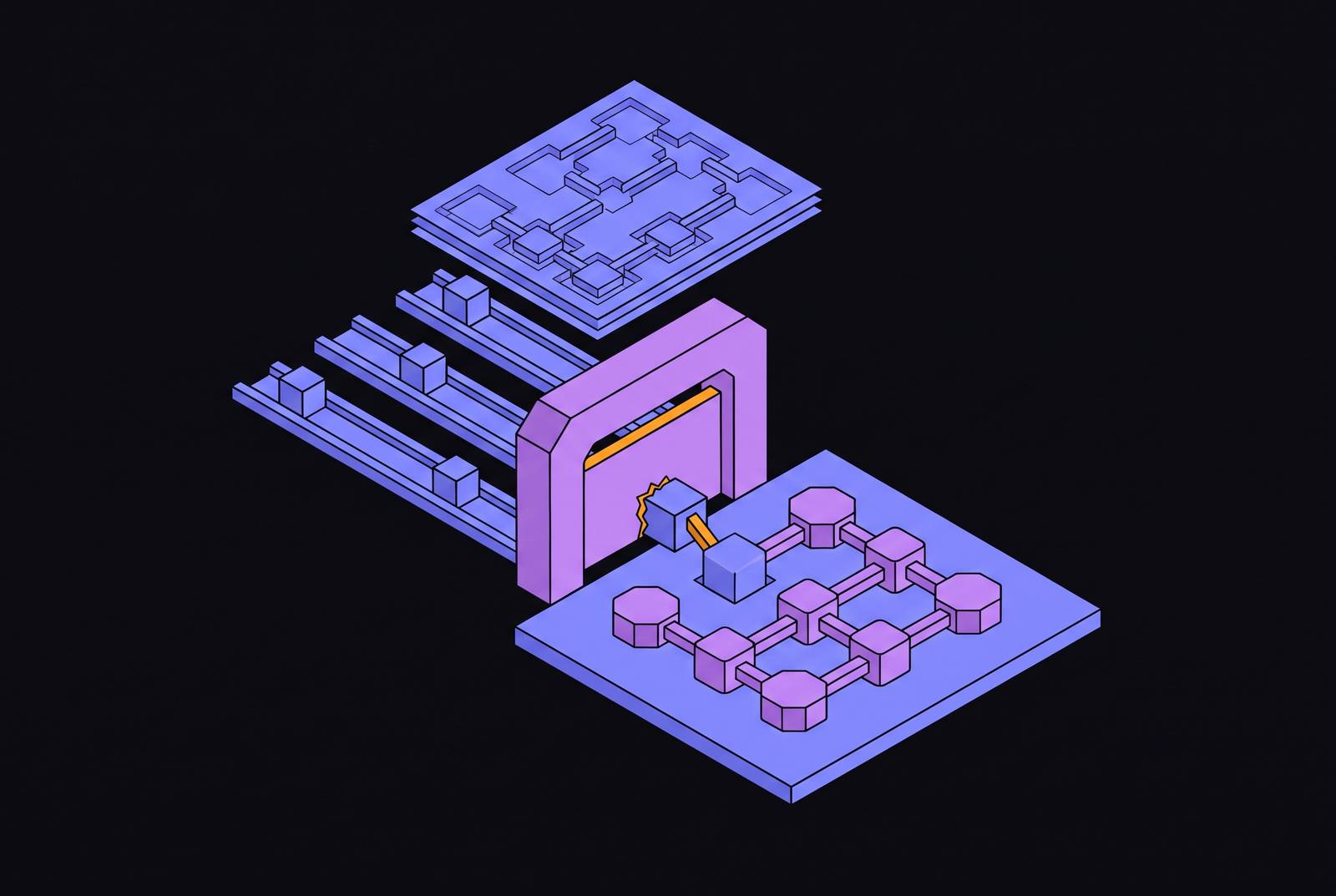
CI enforcement of architectural constraints requires a deterministic graph-level policy check that blocks merges when code violates declared dependency rules. ArchUnit for Java and Dependency Cruiser for JavaScript provide mechanisms for expressing those rules as executable checks. Architectural intent holds up at the speed of agents only if enforcement is automatic, model-independent, and required before merge.
Why AI agents produce architectural violations faster than any human process can catch them
Apiiro’s September 2025 report found an inversion in the defect profile across Fortune 50 enterprise repositories, with architectural design flaws rising sharply while trivial syntax errors dropped. Syntax and local behavior can be correct while dependencies cross boundaries that the architecture forbids. Passing tests alone cannot show that the code’s structure is correct. A system can satisfy its immediate requirements while acquiring relationships that undermine its design.
The mechanism begins with what agents optimize for. Passing tests and meeting the immediate prompt reward local correctness, but the agent’s working model may leave out global constraints. An import can help complete a task even when it exposes another module’s private entities or reverses an intended layer dependency. The architectural violation exists in the relationship between components.
Adding more text about the architecture does not reliably get agents to follow those constraints. A May 2026 study named the problem “constraint decay” and found that correctness against architectural requirements degraded as those requirements were layered onto an LLM agent. Data-layer constraints that involved databases and ORM caused most of the approximately 30-point drop in the assertion pass rate. Telling an agent more about the system must be accompanied by establishing an independent way to check that its changes obey the constraints.
That independence becomes essential as generation accelerates. Human review must reconstruct architectural intent from each change, while an agent can keep producing locally plausible code without resolving the global relationships it creates. More output therefore increases the load on the process least suited to checking those relationships repeatedly.
Why documentation and review culture cannot hold the line at agent speed
Stripe’s “Minions” system ships thousands of PRs weekly from Slack reactions. At that throughput, human interpretation of architectural intent on every PR cannot serve as the primary enforcement mechanism. Documentation can explain a boundary, but it cannot stop an import from crossing it. Style guides have the same limitation. Their usefulness as guidance does not make them authoritative controls over what enters the repository.
A diff shows that a module has started importing an entity, but it does not include the intended dependency structure against which that import must be judged. The line can look entirely reasonable in isolation. Its architectural significance depends on which module owns the entity, whether it is private, and which relationships the design permits. Reviewers must supply that missing context before they can identify the violation.
An AI author and AI reviewer can share blind spots, especially when review favors style over structural correctness. Agreement between them is not evidence that the architecture remains intact. Correlated reviewers are effectively one reviewer for the defects they both overlook. A second probabilistic assessment cannot substitute for a declared invariant evaluated mechanically.
The review surface also introduces its own risks. Pillar Security’s 2025 “Rules File Backdoor” documentation showed how hidden instructions in agent configuration files could silently corrupt generated code, while CVE-2025-53773 demonstrated hidden PR-description instructions reaching remote code execution through an AI coding assistant.
Bokkasam and Durgalakshmi’s September 2026 paper describes a wider gap in enforcement: organizations have governance policies but lack evidence that can be audited to show those policies were enforced. Architectural documentation faces the same structural test. It records intent, but a separate mechanism must intervene before an incompatible change is accepted.
What a graph-level policy check actually does that a diff and a linter cannot
A graph-level architecture policy check evaluates the codebase’s dependency structure against explicit rules. Modules or classes are the nodes, and their dependencies are the edges being checked. The relevant defect is a forbidden relationship. A diff exposes the changed line, while graph analysis establishes what that line connects and whether the connection violates a declared boundary. A syntax linter does not answer that architectural question merely by accepting the code.
Neal Ford, Rebecca Parsons, Patrick Kua, and Pramod Sadalage’s Building Evolutionary Architectures, published in its second edition in 2022, popularized “fitness function” for executable checks of measurable architectural properties. Those properties include dependency depth, coupling metrics, latency budgets, and security boundaries. The term connects architectural intent to a repeatable test.
ArchUnit does this for Java, while Dependency Cruiser analyzes dependencies and checks rules for JavaScript. These tools turn code structure into relationships that can be evaluated through test-like assertions, such as a rule that classes in one package must not depend on classes in another. Their shared purpose is to evaluate dependencies across package boundaries against policy, so a locally valid import can still produce an architectural failure.
Vijay and Ethiraj’s G-SPEC framework found that deterministic graph validation contributed 68% of safety gains in its study of agentic network control. Muth and Margraf’s ASSERT framework similarly uses deterministic graph comparison, decoupled from probabilistic text generation, to make compliance errors measurable and reproducible.
For repository enforcement, the useful output is specific. A failure identifies the violating edge and scoped rule, linked to the accepted design record, rather than presenting the entire graph as an unexplained problem. This moves enforcement from post-hoc interpretation of generated text to a pre-merge decision grounded in code structure.
How do you prevent architecture violations before code gets merged?
A graph check becomes authoritative when CI requires it to pass before merge. On an architect’s workstation, it depends on that person running it against the relevant change. In a team ritual, it depends on attendance, attention, and timing. Neither location controls admission to the repository. A required CI check connects the architectural decision directly to the point where the change becomes accepted code.
The practical sequence is to express the boundary as policy, version it with the code, evaluate the dependency graph in CI, and make failure block the merge. For Java, ArchUnit supplies the executable architecture assertions. For JavaScript, Dependency Cruiser has dependency rules that can enforce the same boundaries.
Versioning the graph and policy with the repository also makes the decision auditable and the check reproducible across commits. A diagram kept elsewhere cannot tie the decision and check to commits just by showing the intended design. Policy and implementation must be evaluated together. Otherwise, reviewers still have to decide whether an architecture described outside the repository applies to the change being merged.
The gate must also remain independent of its author. The practical rule emerging in 2026 is that an agent’s PR passes the same gates as a human’s, with a person owning the tests that define behavior and the agent unable to edit them merely to make its code pass. A fitness function rejects infrastructure imported into the domain when the policy forbids that relationship, regardless of model upgrades.
Pipeline latency is a legitimate implementation concern, but not a reason to relocate enforcement into an optional process. SonarQube’s scan-time improvement shows how that wait can be reduced. The result must still arrive before merge and control whether the change can go ahead.
The strongest objection is that gates bypassed under pressure are no better than documents
The objection is legitimate because CI placement alone does not make a rule non-negotiable. Teams under deadline pressure can override failing gates, and an invisible override creates false confidence that the constraint was enforced. The repository may appear protected while accepting precisely the dependencies the policy prohibits.
Bypass must be visible, auditable, and costly. The check’s authority must be part of the tooling decision. When a check fails, the violation should be fixed. Where a bypass occurs, its visibility must prevent the organization from confusing an exception with successful compliance.
Legacy debt creates a different pressure toward bypass. A repository with existing boundary violations may fail immediately under a newly introduced policy, making comprehensive repair appear to be a prerequisite for adoption. Ratchet baselining avoids that trap by freezing existing architectural debt and failing CI on new violations. The gate can be authoritative from introduction without pretending that historical debt has already been removed.
A baseline openly states which existing violations remain. An invisible override conceals that a required rule was not applied. The former supports incremental adoption. The latter weakens the evidence that the gate is supposed to provide and makes its apparent coverage unreliable.
G-SPEC’s ablation studies sharpen the reason to protect the validation step, with graph validation contributing more safety gains than the policy constraint layer or model fine-tuning. Weakening that step removes the strongest protection in that framework. AI review can still contribute judgment, but it cannot replace the independent check simply because resolving a deterministic failure is inconvenient.
What the developer’s role becomes when policy enforcement is automated
Instead of repeatedly reconstructing dependency rules from agent-generated diffs, engineers define the constraints, steer agents within the architectural model, and own decisions about what the system may do. Mechanical checks test the declared properties, while people still have to choose those properties and decide whether they match the intended design.
This division fits a development cycle increasingly shaped by large asynchronous batches rather than small, frequent human commits. Reviewing every generated line for every architectural relationship is an expensive way to recover information the system could evaluate directly. The graph provides a better working abstraction. Developers can plan agent work in terms of permitted relationships and system boundaries, with CI enforcing those decisions when the resulting code is proposed for merge.
METR’s 2025 randomized trial found that experienced developers took longer with AI even though they thought they were faster. That result calls into question the belief that faster generation always leads to faster engineering. The remaining review and correction work must be considered. Automated architectural checks address a specific part of that work by removing the need to rediscover mechanically detectable boundary violations on each PR.
SonarSource’s research conclusion describes the stakes as amplification, with AI increasing efficiency in a well-architected system and increasing chaos in a disordered one. A required graph gate gives developers a way to preserve the boundaries on which that efficiency depends. It makes their declared decisions operative while agents produce the implementation.
The graph consequently becomes more than an enforcement artifact. It is a steering interface that lets developers state their architectural intent, guide generated changes, and get precise evidence when those changes stray from the model. With the merge gate handling repeatable structural checks, engineers gain room for the work that requires judgment, including designing boundaries, evaluating trade-offs, and deciding how the system should evolve.
Sources
- Graph-Symbolic Policy Enforcement and Control (G-SPEC): A Neuro-Symbolic Framework for Safe Agentic AI in 5G Autonomous Networks
- Governing at Machine Speed: An Adaptive Intelligence Architecture for Real-Time AI Policy Enforcement
- Reverse Engineering Compliance: A Dual-Graph Verification Framework for Auditing Legacy IT Security Concepts
- How to enforce architectural decisions in CI · AsDecided